Why CRI Should Be Your Top Selection Criterion for Choosing the Best OT Lights in India
Why CRI Should Be Your Top Selection Criterion for Choosing the Best OT Lights in India

Share:
Share
When hospitals evaluate surgical lighting systems, brightness is usually the first metric under consideration. However, modern surgeries want a lot more than just “bright” illumination. Surgeons need light that reproduces colors with perfect accuracy, supports clear tissue differentiation, and helps reduce visual fatigue over long procedures.
This is where CRI, or Color Rendering Index, plays a crucial role. For healthcare facilities evaluating the best OT lights in India , CRI has become one of the most important specifications, as accurate color rendering supports clearer judgement, faster decision-making, and smoother surgical turnaround.
What Is CRI for OT Lights?
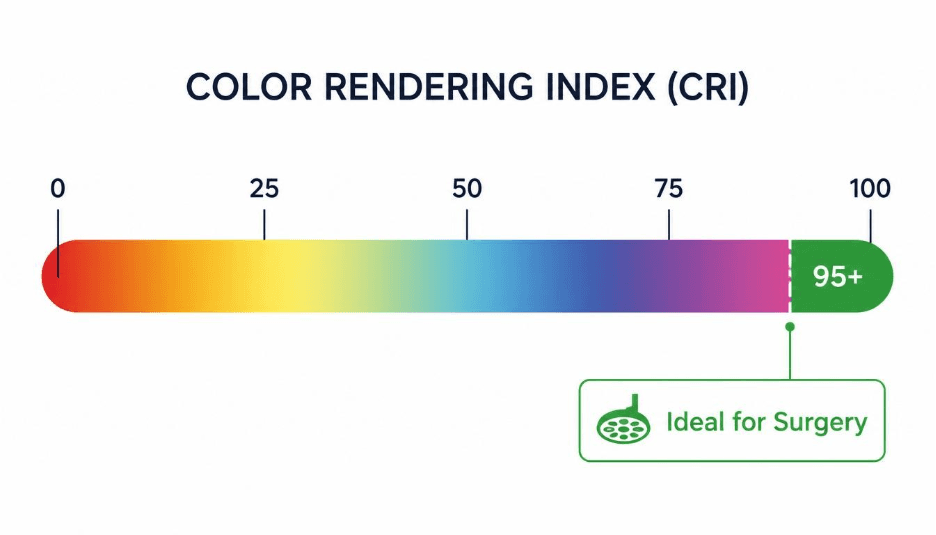
CRI measures how well the light source reproduces colors compared to natural daylight. It is measured on a scale of 0 to 100 where higher values are better (more accurate in color).
In surgery, even slight variations in color can be of clinical importance. It is important to have good color rendering to distinguish between healthy and diseased tissue, to locate blood vessels, and to assess tissue perfusion.
Most of the advanced operation theatre lights now give CRI values greater than 95 to provide better visualisation during procedures.
Why is CRI Important in Surgery?
Improved Tissue Differentiation
High CRI in OT lights help surgeons identify subtle differences in tissue color that might otherwise be missed. This is even more critical in areas such as oncology, neurosurgery, and cardiovascular procedures where precision means everything.
Better Visualisation
The correct color reproduction allows the surgeon to better recognize the bleeding points, the blood vessels, and the boundaries of the tissue, thus reducing the possibility of visual errors during surgery.
Less fatigue for the surgeon
Poor lighting can cause eye strain, especially for long and complicated procedures. Surgical lights with high CRI provide a more natural visual environment, enabling surgeons to work for longer periods of time.
Risks of Low CRI Surgical Lights
Even the brightest lighting setups can compromise with visualisation if their CRI turns out to be low. Common issues linked to low colour rendering are:
Appearance of washed-out tissue
Trouble differentiating anatomical structures
Excessive eye strain
Reduced surgical precision
For that reason, hospitals that are serious about investing in the best OT lights in India are taking more than just lux into consideration before selecting a product; they are also looking closely at its color rendering performance.
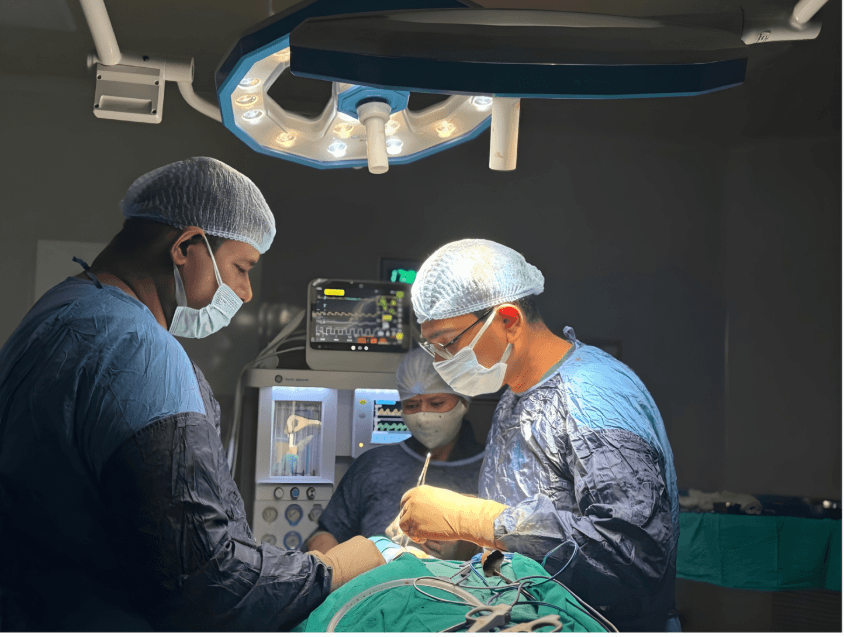
Dr. Anil Dumbare, Onco Surgeon performing surgery under Celesta Pro OT Lights:
CRI vs Brightness: Which Matters More?
Both parameters are important, but they serve different purposes.
Parameter | Brightness (Lux) | CRI (Color Rendering Index) |
What it measures | The intensity or amount of light reaching the surgical field | The accuracy with which colors are reproduced under the light source |
Primary purpose | Ensures adequate illumination of the operative site | Ensures accurate visualization of tissues, blood, and anatomical structures |
Impact on surgery | Improves visibility but does not guarantee true color perception | Enables precise tissue differentiation and better identification of blood vessels and organs |
Can high values alone ensure better outcomes? | No. High lux with poor color rendering can still compromise surgical visualization | No. High CRI should be combined with adequate illumination for optimal performance |
Clinical significance | Important for maintaining a well-lit surgical field | Critical for surgical precision, diagnosis, and reducing visual fatigue |
Recommended range for modern OT lights | Typically 100,000–160,000 lux, depending on the procedure | Ideally above 95 for advanced surgical applications |
What Should Hospitals Look for in OT Lights?
When evaluating operation theatre lights, hospitals should consider:
✔ CRI above 95
✔ High R9 value for better red color rendering
✔ Uniform illumination
✔ Shadow reduction technology
✔ Adjustable color temperature
✔ Long LED lifespan
A high-performing surgical light is not just bright; it delivers accurate and consistent visualization throughout the procedure.
Designing OT Lighting for Modern Surgical Demands
Modern operating rooms need lighting systems that do more than just illuminate the surgical field. Todays operation theatre lights are supposed to help with correct tissue visualization, minimize shadows, and reduce surgeon fatigue during lengthy and complex procedures.
At Matrix Medicals, the main idea is to understand the practical needs of surgeons and healthcare facilities when they are assessing surgical lighting systems. Important points include:
High CRI for accurate tissue and blood color representation
Uniform illumination across the operative field
Effective shadow management and improved depth perception with isometric luminance
Visual comfort and heatless functioning during prolonged procedures
Reliable performance across different surgical specialties
As hospitals increasingly look for the best OT lights in India, factors such as color rendering, visualization quality, and surgeon comfort are getting as important, if not more, as illumination intensity. The point of today’s surgical lighting is not just to make the field feel brighter but to help clinicians see more precisely and work with greater confidence.
Conclusion
As operating rooms keep evolving, choosing surgical lights by brightness alone just isn't enough anymore. The CRI value in OT lights is a big deal, because it directly shapes tissue differentiation, affects how comfortable the surgeon feels, and even affects procedural accuracy.
For hospitals looking for the best OT lights in India, they should really focus on lighting systems that blend strong illumination with excellent color rendering. Investing into high-CRI surgical lights is basically an investment toward clearer visualization, better surgical performance, and stronger patient outcomes.
When hospitals evaluate surgical lighting systems, brightness is usually the first metric under consideration. However, modern surgeries want a lot more than just “bright” illumination. Surgeons need light that reproduces colors with perfect accuracy, supports clear tissue differentiation, and helps reduce visual fatigue over long procedures.
This is where CRI, or Color Rendering Index, plays a crucial role. For healthcare facilities evaluating the best OT lights in India , CRI has become one of the most important specifications, as accurate color rendering supports clearer judgement, faster decision-making, and smoother surgical turnaround.
What Is CRI for OT Lights?
CRI measures how well the light source reproduces colors compared to natural daylight. It is measured on a scale of 0 to 100 where higher values are better (more accurate in color).
In surgery, even slight variations in color can be of clinical importance. It is important to have good color rendering to distinguish between healthy and diseased tissue, to locate blood vessels, and to assess tissue perfusion.
Most of the advanced operation theatre lights now give CRI values greater than 95 to provide better visualisation during procedures.
Why is CRI Important in Surgery?
Improved Tissue Differentiation
High CRI in OT lights help surgeons identify subtle differences in tissue color that might otherwise be missed. This is even more critical in areas such as oncology, neurosurgery, and cardiovascular procedures where precision means everything.
Better Visualisation
The correct color reproduction allows the surgeon to better recognize the bleeding points, the blood vessels, and the boundaries of the tissue, thus reducing the possibility of visual errors during surgery.
Less fatigue for the surgeon
Poor lighting can cause eye strain, especially for long and complicated procedures. Surgical lights with high CRI provide a more natural visual environment, enabling surgeons to work for longer periods of time.
Risks of Low CRI Surgical Lights
Even the brightest lighting setups can compromise with visualisation if their CRI turns out to be low. Common issues linked to low colour rendering are:
Appearance of washed-out tissue
Trouble differentiating anatomical structures
Excessive eye strain
Reduced surgical precision
For that reason, hospitals that are serious about investing in the best OT lights in India are taking more than just lux into consideration before selecting a product; they are also looking closely at its color rendering performance.
Dr. Anil Dumbare, Onco Surgeon performing surgery under Celesta Pro OT Lights:
CRI vs Brightness: Which Matters More?
Both parameters are important, but they serve different purposes.
Parameter | Brightness (Lux) | CRI (Color Rendering Index) |
What it measures | The intensity or amount of light reaching the surgical field | The accuracy with which colors are reproduced under the light source |
Primary purpose | Ensures adequate illumination of the operative site | Ensures accurate visualization of tissues, blood, and anatomical structures |
Impact on surgery | Improves visibility but does not guarantee true color perception | Enables precise tissue differentiation and better identification of blood vessels and organs |
Can high values alone ensure better outcomes? | No. High lux with poor color rendering can still compromise surgical visualization | No. High CRI should be combined with adequate illumination for optimal performance |
Clinical significance | Important for maintaining a well-lit surgical field | Critical for surgical precision, diagnosis, and reducing visual fatigue |
Recommended range for modern OT lights | Typically 100,000–160,000 lux, depending on the procedure | Ideally above 95 for advanced surgical applications |
What Should Hospitals Look for in OT Lights?
When evaluating operation theatre lights, hospitals should consider:
✔ CRI above 95
✔ High R9 value for better red color rendering
✔ Uniform illumination
✔ Shadow reduction technology
✔ Adjustable color temperature
✔ Long LED lifespan
A high-performing surgical light is not just bright; it delivers accurate and consistent visualization throughout the procedure.
Designing OT Lighting for Modern Surgical Demands
Modern operating rooms need lighting systems that do more than just illuminate the surgical field. Todays operation theatre lights are supposed to help with correct tissue visualization, minimize shadows, and reduce surgeon fatigue during lengthy and complex procedures.
At Matrix Medicals, the main idea is to understand the practical needs of surgeons and healthcare facilities when they are assessing surgical lighting systems. Important points include:
High CRI for accurate tissue and blood color representation
Uniform illumination across the operative field
Effective shadow management and improved depth perception with isometric luminance
Visual comfort and heatless functioning during prolonged procedures
Reliable performance across different surgical specialties
As hospitals increasingly look for the best OT lights in India, factors such as color rendering, visualization quality, and surgeon comfort are getting as important, if not more, as illumination intensity. The point of today’s surgical lighting is not just to make the field feel brighter but to help clinicians see more precisely and work with greater confidence.
Conclusion
As operating rooms keep evolving, choosing surgical lights by brightness alone just isn't enough anymore. The CRI value in OT lights is a big deal, because it directly shapes tissue differentiation, affects how comfortable the surgeon feels, and even affects procedural accuracy.
For hospitals looking for the best OT lights in India, they should really focus on lighting systems that blend strong illumination with excellent color rendering. Investing into high-CRI surgical lights is basically an investment toward clearer visualization, better surgical performance, and stronger patient outcomes.
Share:
Share
RELATED ARTICLES
Read more from our blogs
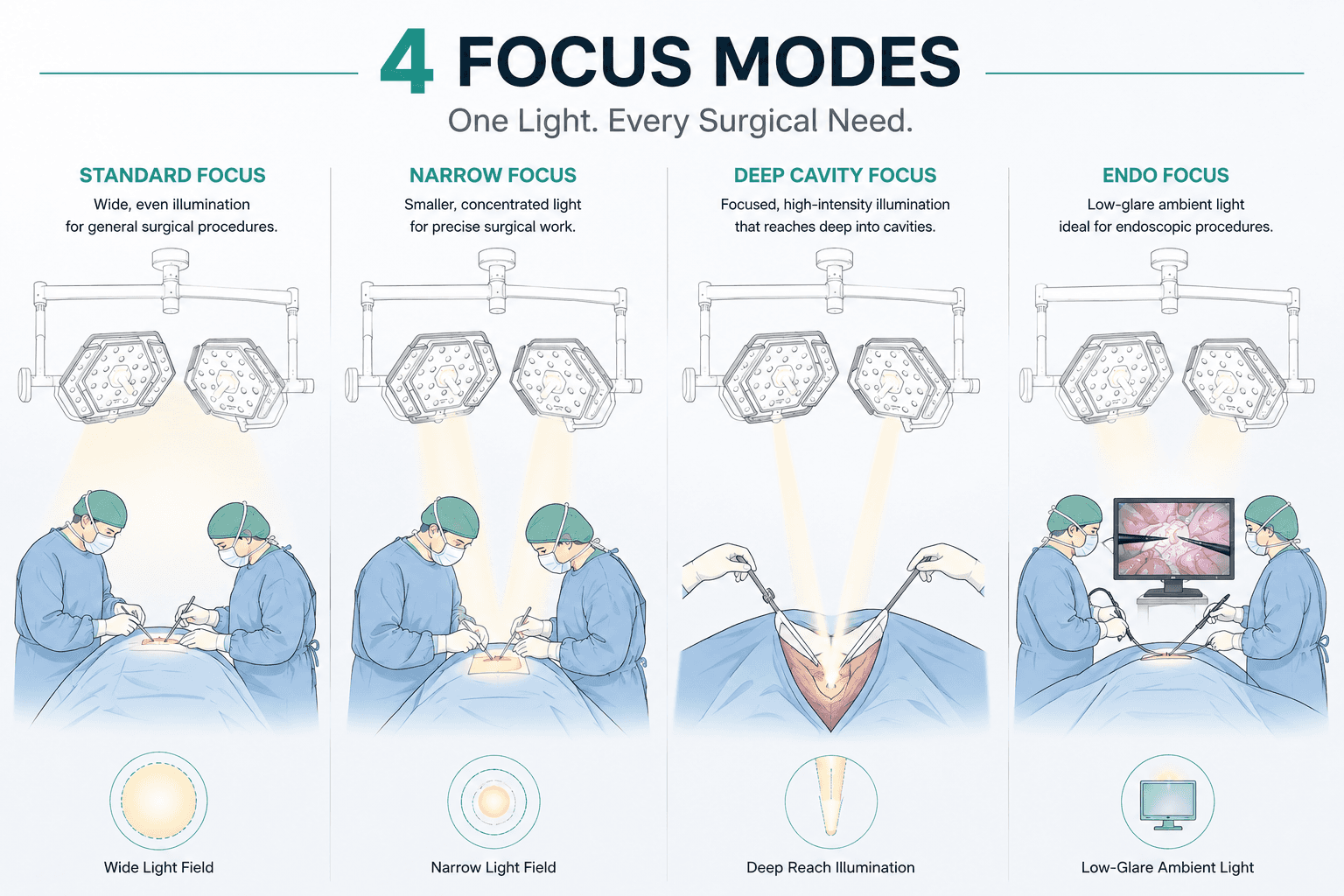
What Are the Different Focus Modes in Modern Surgical Theatre Lights?
What Are the Different Focus Modes in Modern Surgical Theatre Lights?

How Advanced MedTech Solutions Are Improving Surgical Precision and Efficiency
How Advanced MedTech Solutions Are Improving Surgical Precision and Efficiency

How Hospitals Should Evaluate Medical Equipment Before Procurement
How Hospitals Should Evaluate Medical Equipment Before Procurement

C-Arm Compatible OT Tables: What Hospitals Should Check Before Buying
C-Arm Compatible OT Tables: What Hospitals Should Check Before Buying

Products
Get in touch


info@matrixmedicals.in

+91 7304411451
+91 9821235552
Copyright © 2026 Matrix Medicals Pvt. Ltd., All rights reserved.
Products
Get in touch
info@matrixmedicals.in
+91 7304411451
+91 9821235552
Copyright © 2026 Matrix Medicals Pvt. Ltd., All rights reserved.
Contact Us
Contact Us
Contact Us