Inside SpectraSure™: Multi-Spectral Technology for Advanced OT Lights
Inside SpectraSure™: Multi-Spectral Technology for Advanced OT Lights

Share:
Share
Operating room lighting has evolved beyond simple brightness. For years, the main benchmark for OT lights was lux. But as procedures grow more complex, hospitals are asking a different question: not just how bright the light is, but how accurately it renders tissue, blood, and anatomical structures.
This is where SpectraSure™ comes in, a clinically optimised, multi-spectral illumination technology built to render color and depth with precision, rather than simply maximising intensity. Brightness still matters, but spectral quality is now an equally critical factor in surgical visualisation. This article looks at the engineering behind SpectraSure™ and why it reflects a broader evolution in modern led ot lights.
What Is SpectraSure™ Multi-Spectral Technology?
SpectraSure™ addresses a specific engineering problem: standard surgical lights are typically optimized around a generic, overall Color Rendering Index (CRI) score. That single average figure frequently neglects two narrower but clinically critical values, deep-red rendering (R9) and soft-tissue rendering (R13), both necessary for accurate hemoglobin and tissue differentiation.
A fixture can post a high CRI while still under-rendering the deep reds and subtle skin tones that matter most in surgery. In simple terms, SpectraSure™ combines:
A proprietary multi-spectral LED platform, rather than a standard white-light LED array
Custom LED emitter configurations covering clinically relevant portions of the visible spectrum
Precision spectral calibration algorithms, tuning output rather than relying on default LED characteristics
Optimised light distribution across wavelength bands important for tissue and vascular visualization
The intent is to engineer the light's spectral output around real surgical viewing needs, not just a single brightness or color-accuracy number.
The Engineering Behind SpectraSure™
SpectraSure™ blends custom emitter configurations with precise calibration algorithms designed to fill the wavelength regions where standard lighting falls short, particularly deep-red and mid-tissue-tone ranges.
Balancing wavelengths matters because a surgeon's ability to distinguish tissue planes depends on more than raw output. A light can be extremely bright and still make it harder to differentiate a vessel from surrounding tissue if the spectral balance is off. Optimizing specific portions of the spectrum is a fundamentally different engineering problem than simply increasing lux.
As measured performance benchmarks, SpectraSure™ delivers:
CRI up to 98
R9 red values exceeding 95 (deep red rendering, tied to hemoglobin and vascular structures)
R13 skin and soft-tissue rendering at 99+
These specifications are engineered into the platform and deployed across EnvoLite™ LED light sources, as well as the Celesta™ and Constella™ luminaires. The objective across these lines is consistent: deliver controlled, clinically informed spectral output rather than chasing higher brightness figures alone.
The underlying emitter combinations and calibration methods are protected through active trademark enforcement of the SpectraSure™, EnvoLite™, Celesta™, and Constella™ names, paired with proprietary calibration algorithms and manufacturing know-how held as trade secrets.
Why Multi-Spectral Lighting Is Becoming Important in OT Lights
Surgical procedures have grown more intricate, with greater reliance on precise visualization of fine anatomical structures and vasculature, particularly in minimally invasive and microsurgical settings. As the margin for visual ambiguity has shrunk, the demands placed on modern led ot lights have grown accordingly.
The industry has also largely completed its shift from halogen to LED illumination. LEDs offer efficiency and heat management advantages, but LED spectral output isn't inherently uniform across all wavelengths the way older sources were. This has pushed manufacturers toward spectrum-focused design for led lights for operation theatre use, rather than brightness alone.
The result is a broader shift from lighting evaluated mainly on lux to lighting evaluated on how well it reproduces clinically important colors, which is why the spectral behavior of led lights for operation theatre use is receiving greater attention in OR design and procurement.

Understanding CRI, R9, and R13 in Surgical Lighting
CRI measures overall color accuracy compared to natural daylight, and is widely specified because it offers a single, easy-to-compare number.
R9 measures deep red rendering, closely tied to hemoglobin, blood, muscle, and vascular structures. A light with strong CRI but weak R9 may still struggle to render these tissues clearly.
R13 measures skin and soft-tissue rendering, supporting more natural visualization of anatomical structures across open and minimally invasive procedures.
Together, CRI, R9, and R13 give a far more complete picture of performance than CRI alone, closing the gap that multi-spectral engineering is designed to address.
How Multi-Spectral OT Lights Support Surgical Visualization
Multi-spectral engineering in modern led ot lights is designed to support:
More natural tissue appearance under illumination
Better differentiation between tissue types
Improved perception of blood vessels
Consistent color reproduction throughout a procedure
Reduced need to mentally compensate for color shifts
Both open and minimally invasive procedures
This kind of illumination is designed to support and can help improve visualization, it isn't a substitute for surgical skill, and outcomes depend on many factors beyond lighting. Good spectral engineering aims to provide a more accurate, consistent visual foundation for the surgical team.
What Should Hospitals Look for Beyond Lux When Choosing OT Lights?
For hospitals evaluating OT lights, lux alone is incomplete. A fuller evaluation should also weigh CRI, R9, and R13 values; spectral optimization; shadow management; color temperature; uniform illumination; depth of illumination; and LED optical design. Lighting performance is the result of multiple engineering parameters working together, spectral, optical, and mechanical.
Conclusion
SpectraSure™ reflects the growing emphasis on spectral engineering in surgical lighting. Modern OT lights are increasingly evaluated not just for brightness, but for their ability to accurately reproduce clinically important colors, deep reds, skin tones, and the subtle variations that help surgeons distinguish tissue types.
Understanding CRI, R9, and R13 gives hospitals a more informed basis for comparing surgical lighting technologies. As operating rooms evolve, multi-spectral illumination is becoming an important consideration for hospitals seeking consistent, high-quality visualization from their led lights for operation theatre installations.
Operating room lighting has evolved beyond simple brightness. For years, the main benchmark for OT lights was lux. But as procedures grow more complex, hospitals are asking a different question: not just how bright the light is, but how accurately it renders tissue, blood, and anatomical structures.
This is where SpectraSure™ comes in, a clinically optimised, multi-spectral illumination technology built to render color and depth with precision, rather than simply maximising intensity. Brightness still matters, but spectral quality is now an equally critical factor in surgical visualisation. This article looks at the engineering behind SpectraSure™ and why it reflects a broader evolution in modern led ot lights.
What Is SpectraSure™ Multi-Spectral Technology?
SpectraSure™ addresses a specific engineering problem: standard surgical lights are typically optimized around a generic, overall Color Rendering Index (CRI) score. That single average figure frequently neglects two narrower but clinically critical values, deep-red rendering (R9) and soft-tissue rendering (R13), both necessary for accurate hemoglobin and tissue differentiation.
A fixture can post a high CRI while still under-rendering the deep reds and subtle skin tones that matter most in surgery. In simple terms, SpectraSure™ combines:
A proprietary multi-spectral LED platform, rather than a standard white-light LED array
Custom LED emitter configurations covering clinically relevant portions of the visible spectrum
Precision spectral calibration algorithms, tuning output rather than relying on default LED characteristics
Optimised light distribution across wavelength bands important for tissue and vascular visualization
The intent is to engineer the light's spectral output around real surgical viewing needs, not just a single brightness or color-accuracy number.
The Engineering Behind SpectraSure™
SpectraSure™ blends custom emitter configurations with precise calibration algorithms designed to fill the wavelength regions where standard lighting falls short, particularly deep-red and mid-tissue-tone ranges.
Balancing wavelengths matters because a surgeon's ability to distinguish tissue planes depends on more than raw output. A light can be extremely bright and still make it harder to differentiate a vessel from surrounding tissue if the spectral balance is off. Optimizing specific portions of the spectrum is a fundamentally different engineering problem than simply increasing lux.
As measured performance benchmarks, SpectraSure™ delivers:
CRI up to 98
R9 red values exceeding 95 (deep red rendering, tied to hemoglobin and vascular structures)
R13 skin and soft-tissue rendering at 99+
These specifications are engineered into the platform and deployed across EnvoLite™ LED light sources, as well as the Celesta™ and Constella™ luminaires. The objective across these lines is consistent: deliver controlled, clinically informed spectral output rather than chasing higher brightness figures alone.
The underlying emitter combinations and calibration methods are protected through active trademark enforcement of the SpectraSure™, EnvoLite™, Celesta™, and Constella™ names, paired with proprietary calibration algorithms and manufacturing know-how held as trade secrets.
Why Multi-Spectral Lighting Is Becoming Important in OT Lights
Surgical procedures have grown more intricate, with greater reliance on precise visualization of fine anatomical structures and vasculature, particularly in minimally invasive and microsurgical settings. As the margin for visual ambiguity has shrunk, the demands placed on modern led ot lights have grown accordingly.
The industry has also largely completed its shift from halogen to LED illumination. LEDs offer efficiency and heat management advantages, but LED spectral output isn't inherently uniform across all wavelengths the way older sources were. This has pushed manufacturers toward spectrum-focused design for led lights for operation theatre use, rather than brightness alone.
The result is a broader shift from lighting evaluated mainly on lux to lighting evaluated on how well it reproduces clinically important colors, which is why the spectral behavior of led lights for operation theatre use is receiving greater attention in OR design and procurement.
Understanding CRI, R9, and R13 in Surgical Lighting
CRI measures overall color accuracy compared to natural daylight, and is widely specified because it offers a single, easy-to-compare number.
R9 measures deep red rendering, closely tied to hemoglobin, blood, muscle, and vascular structures. A light with strong CRI but weak R9 may still struggle to render these tissues clearly.
R13 measures skin and soft-tissue rendering, supporting more natural visualization of anatomical structures across open and minimally invasive procedures.
Together, CRI, R9, and R13 give a far more complete picture of performance than CRI alone, closing the gap that multi-spectral engineering is designed to address.
How Multi-Spectral OT Lights Support Surgical Visualization
Multi-spectral engineering in modern led ot lights is designed to support:
More natural tissue appearance under illumination
Better differentiation between tissue types
Improved perception of blood vessels
Consistent color reproduction throughout a procedure
Reduced need to mentally compensate for color shifts
Both open and minimally invasive procedures
This kind of illumination is designed to support and can help improve visualization, it isn't a substitute for surgical skill, and outcomes depend on many factors beyond lighting. Good spectral engineering aims to provide a more accurate, consistent visual foundation for the surgical team.
What Should Hospitals Look for Beyond Lux When Choosing OT Lights?
For hospitals evaluating OT lights, lux alone is incomplete. A fuller evaluation should also weigh CRI, R9, and R13 values; spectral optimization; shadow management; color temperature; uniform illumination; depth of illumination; and LED optical design. Lighting performance is the result of multiple engineering parameters working together, spectral, optical, and mechanical.
Conclusion
SpectraSure™ reflects the growing emphasis on spectral engineering in surgical lighting. Modern OT lights are increasingly evaluated not just for brightness, but for their ability to accurately reproduce clinically important colors, deep reds, skin tones, and the subtle variations that help surgeons distinguish tissue types.
Understanding CRI, R9, and R13 gives hospitals a more informed basis for comparing surgical lighting technologies. As operating rooms evolve, multi-spectral illumination is becoming an important consideration for hospitals seeking consistent, high-quality visualization from their led lights for operation theatre installations.
Share:
Share
RELATED ARTICLES
Read more from our blogs
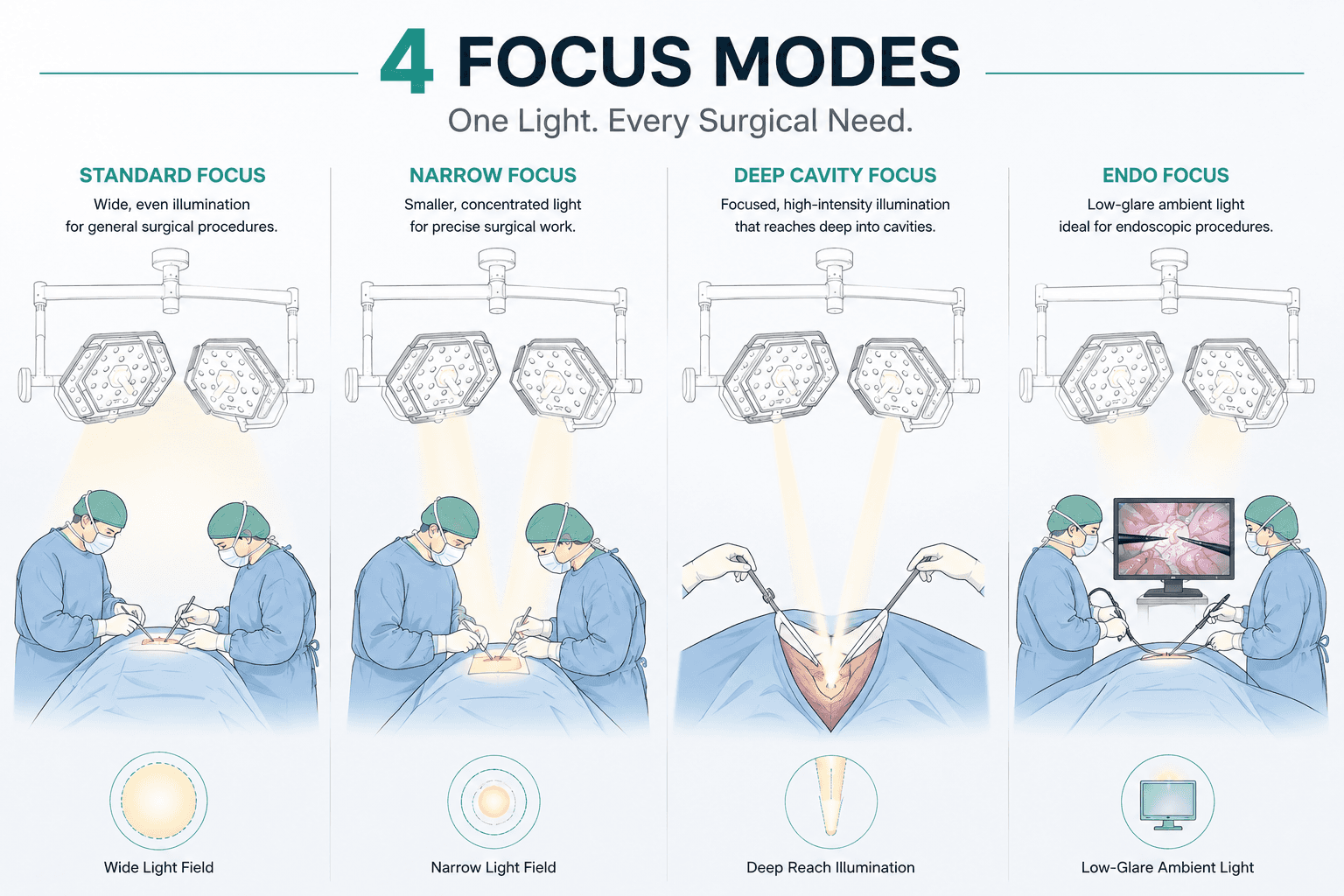
What Are the Different Focus Modes in Modern Surgical Theatre Lights?
What Are the Different Focus Modes in Modern Surgical Theatre Lights?

How Advanced MedTech Solutions Are Improving Surgical Precision and Efficiency
How Advanced MedTech Solutions Are Improving Surgical Precision and Efficiency

How Hospitals Should Evaluate Medical Equipment Before Procurement
How Hospitals Should Evaluate Medical Equipment Before Procurement

C-Arm Compatible OT Tables: What Hospitals Should Check Before Buying
C-Arm Compatible OT Tables: What Hospitals Should Check Before Buying

Products
Get in touch


info@matrixmedicals.in

+91 7304411451
+91 9821235552
Copyright © 2026 Matrix Medicals Pvt. Ltd., All rights reserved.
Products
Get in touch
info@matrixmedicals.in
+91 7304411451
+91 9821235552
Copyright © 2026 Matrix Medicals Pvt. Ltd., All rights reserved.
Contact Us
Contact Us
Contact Us