What Makes a High-Quality Endoscopic LED Light Source? Key Factors Surgeons Should Consider `
What Makes a High-Quality Endoscopic LED Light Source? Key Factors Surgeons Should Consider `

Share:
Share
LED endoscopic light sources are everywhere on the market now, but only a few buyers stop asking what makes one good, reliable, and safe. The answer starts with a simple truth about how endoscopic imaging works: the camera is just a sensor. It cannot create detail that the light fails to deliver, which means image quality is decided upstream, by the Endoscopic LED Light Source itself, long before it ever reaches the monitor.
A high-quality endoscopic light source should be judged on more than brightness or an advertised LED lifespan. Color reproduction, optical efficiency, thermal management, reliability and safety all play a role in how clearly a surgical team can see what they're operating on. Good endoscopic visualization begins with controlled, consistent, and reliable illumination that the entire imaging chain can depend on.
What Should You Look for in an Endoscopic LED Light Source?
Before getting into the technical details, it helps to lay out the main criteria worth evaluating in any Endoscopic LED Light Source: optical quality and illumination consistency, color fidelity, a meaningful measurement of LED operating life, thermal management, fiber-optic cable safety, ease of control and usability, advanced fluorescence capabilities, and certifications and system compatibility. The ENVOLITE platform is a useful reference point for walking through each of these in turn.
Color Fidelity: Why CRI, R9 and R13 Matter
Brightness alone doesn't determine the quality of surgical illumination. The spectrum of the light itself influences how naturally tissue colors are represented on screen. This is where the Color Rendering Index (CRI) comes in, a commonly used measure of how accurately a light source renders color compared to natural light. Within that, two sub-indices matter especially for surgical applications: R9, which relates to strong red tones, and R13, which relates to the rendering of skin and complexion-related colors. Higher color fidelity across these metrics helps a visualization system reproduce tissue appearance more naturally, so that the colors reaching the tip of the scope are the colors the surgeon sees.
The engineering behind these advances is rooted in more than a decade of specialized research. Dr. Rohan Nagare, Director of Technology and R&D at EPMD, holds a B.Tech from IIT Dhanbad and an M.S. and Ph.D. from Rensselaer Polytechnic Institute, New York. Since 2011, his research in light, health and engineering systems has driven EPMD's work in surgical illumination and imaging, including the development of intellectual property behind its evolving illumination technologies.
This is precisely the territory SpectraSure™ technology is built for. Positioned as ENVOLITE's high-fidelity illumination engine, SpectraSure™ is specified with a CRI greater than 97, R9 greater than 91, and R13 greater than 99 on the ENVOLITE IRLA 300, with the TCLA 300 variant rated at CRI 95 and offering SpectraSure™ as well; the entry-level SCLA 300 uses a more standard CRI above 70 without it. These figures should be read as the manufacturer's stated specifications, not a claim that CRI alone determines clinical image quality, but they illustrate the precision manufacturers are now engineering toward.
Beyond the "50,000-Hour" Claim: Measuring Real Illumination Time
A 50,000-hour LED life looks impressive on a spec sheet, but it doesn't tell the whole story. There's a meaningful difference between power-on hours, how long a device has simply been switched on, and optical operating hours, which reflect how long the light source has been producing illumination. ENVOLITE units include an in-built optical hour meter that counts real illumination hours rather than power-on time, giving facilities a more accurate way to track utilization and plan maintenance than the raw 50,000-hour figure alone.
Thermal Management: A Critical Factor During Long Procedures
Heat management is easy to overlook, but it deserves real attention when evaluating any endoscopic light source. High-intensity illumination can create thermal considerations around the light path and the fiber-optic cable, and this becomes especially relevant during long procedures. Optical efficiency and heat dissipation should be weighed alongside raw illumination intensity, a well-designed system should deliver strong illumination without transferring unnecessary heat to the cable or surrounding components.
ENVOLITE addresses this through its OptiCore-MX™ platform, which improves optical coupling efficiency to roughly 93% and limits heat rise in the illuminated area to just Δ0.9°C. In practice, this keeps the fiber-optic cable cool enough to touch comfortably, staying under 30°C, even after extended use, while extending the cable's working lifespan. This kind of thermal discipline is quickly becoming a baseline expectation across the industry, not a one-off feature.

Fiber-Optic Cable Safety and Intelligent Cable Detection
The fiber-optic cable is an essential, often underappreciated, part of the illumination pathway. Safety shouldn't depend solely on user awareness in a busy OR, automatic detection can help prevent illumination when a cable isn't properly connected. On ENVOLITE's advanced models, built-in sensors activate the light source only when the cable is securely connected to the output port, and the system automatically shuts off illumination if the cable is accidentally unplugged mid-procedure, reducing the risk of unnecessary exposure or heat-related hazards such as burns and drape fires.
Usability Matters: Controls, Presets and Real-Time Monitoring
Even the most advanced engineering only matters if clinical teams can operate it easily. ENVOLITE is built around a 7-inch capacitive touchscreen, among the largest in its class, offering high-resolution control, easy parameter adjustment and real-time status visualization. A memory function with one-touch saves and recall restores last-used settings, and the dimming range runs 5–100% for fine control over intensity. The system runs under 45 dB, up to 6 dB quieter than conventional light sources, and weighs less than 4.8 kg, making it easy to install and move between ORs. Its optional ultra-lightweight fiber-optic cables, at roughly 3.5 mm core diameter, are over 50% lighter than conventional cables, a small detail that adds over a long procedure.
Future-Ready Illumination: White Light and ICG Fluorescence
Endoscopic platforms are steadily evolving from conventional white-light illumination toward hybrid systems. The ENVOLITE IRLA 300 reflects this shift directly, integrating dual-mode output from a single optical port so surgeons can switch seamlessly between high-intensity white light and precision-tuned infrared excitation for ICG fluorescence imaging, or run both together. With a light output of 3,200 lumens and an industry-leading 98.5% ICG excitation efficacy, it supports visualization of structures such as vessels, blood flow, perfusion and biliary anatomy, delivering markedly clearer fluorescence contrast and depth than conventional systems. The light source, in other words, is increasingly part of a broader advanced imaging platform, not just a conventional illuminator.
Conclusion: Look Beyond Brightness
A high-quality Endoscopic LED Light Source isn't defined by a single specification. It's the combination of optical quality, color fidelity, meaningful operating-life measurement, thermal management, safety, usability and future-ready imaging capabilities working together, backed by certifications like CE, US FDA and CDSCO that confirm the engineering holds up to scrutiny. As the opening point suggested, the camera can only capture what the illumination system enables it to see, which is why the best endoscopic light source for any OR is the one that gets the fundamentals right across all of these areas, not just one. Platforms like ENVOLITE, built on technologies such as SpectraSure™ and OptiCore-MX™, show how manufacturers are approaching these challenges today.
LED endoscopic light sources are everywhere on the market now, but only a few buyers stop asking what makes one good, reliable, and safe. The answer starts with a simple truth about how endoscopic imaging works: the camera is just a sensor. It cannot create detail that the light fails to deliver, which means image quality is decided upstream, by the Endoscopic LED Light Source itself, long before it ever reaches the monitor.
A high-quality endoscopic light source should be judged on more than brightness or an advertised LED lifespan. Color reproduction, optical efficiency, thermal management, reliability and safety all play a role in how clearly a surgical team can see what they're operating on. Good endoscopic visualization begins with controlled, consistent, and reliable illumination that the entire imaging chain can depend on.
What Should You Look for in an Endoscopic LED Light Source?
Before getting into the technical details, it helps to lay out the main criteria worth evaluating in any Endoscopic LED Light Source: optical quality and illumination consistency, color fidelity, a meaningful measurement of LED operating life, thermal management, fiber-optic cable safety, ease of control and usability, advanced fluorescence capabilities, and certifications and system compatibility. The ENVOLITE platform is a useful reference point for walking through each of these in turn.
Color Fidelity: Why CRI, R9 and R13 Matter
Brightness alone doesn't determine the quality of surgical illumination. The spectrum of the light itself influences how naturally tissue colors are represented on screen. This is where the Color Rendering Index (CRI) comes in, a commonly used measure of how accurately a light source renders color compared to natural light. Within that, two sub-indices matter especially for surgical applications: R9, which relates to strong red tones, and R13, which relates to the rendering of skin and complexion-related colors. Higher color fidelity across these metrics helps a visualization system reproduce tissue appearance more naturally, so that the colors reaching the tip of the scope are the colors the surgeon sees.
The engineering behind these advances is rooted in more than a decade of specialized research. Dr. Rohan Nagare, Director of Technology and R&D at EPMD, holds a B.Tech from IIT Dhanbad and an M.S. and Ph.D. from Rensselaer Polytechnic Institute, New York. Since 2011, his research in light, health and engineering systems has driven EPMD's work in surgical illumination and imaging, including the development of intellectual property behind its evolving illumination technologies.
This is precisely the territory SpectraSure™ technology is built for. Positioned as ENVOLITE's high-fidelity illumination engine, SpectraSure™ is specified with a CRI greater than 97, R9 greater than 91, and R13 greater than 99 on the ENVOLITE IRLA 300, with the TCLA 300 variant rated at CRI 95 and offering SpectraSure™ as well; the entry-level SCLA 300 uses a more standard CRI above 70 without it. These figures should be read as the manufacturer's stated specifications, not a claim that CRI alone determines clinical image quality, but they illustrate the precision manufacturers are now engineering toward.
Beyond the "50,000-Hour" Claim: Measuring Real Illumination Time
A 50,000-hour LED life looks impressive on a spec sheet, but it doesn't tell the whole story. There's a meaningful difference between power-on hours, how long a device has simply been switched on, and optical operating hours, which reflect how long the light source has been producing illumination. ENVOLITE units include an in-built optical hour meter that counts real illumination hours rather than power-on time, giving facilities a more accurate way to track utilization and plan maintenance than the raw 50,000-hour figure alone.
Thermal Management: A Critical Factor During Long Procedures
Heat management is easy to overlook, but it deserves real attention when evaluating any endoscopic light source. High-intensity illumination can create thermal considerations around the light path and the fiber-optic cable, and this becomes especially relevant during long procedures. Optical efficiency and heat dissipation should be weighed alongside raw illumination intensity, a well-designed system should deliver strong illumination without transferring unnecessary heat to the cable or surrounding components.
ENVOLITE addresses this through its OptiCore-MX™ platform, which improves optical coupling efficiency to roughly 93% and limits heat rise in the illuminated area to just Δ0.9°C. In practice, this keeps the fiber-optic cable cool enough to touch comfortably, staying under 30°C, even after extended use, while extending the cable's working lifespan. This kind of thermal discipline is quickly becoming a baseline expectation across the industry, not a one-off feature.
Fiber-Optic Cable Safety and Intelligent Cable Detection
The fiber-optic cable is an essential, often underappreciated, part of the illumination pathway. Safety shouldn't depend solely on user awareness in a busy OR, automatic detection can help prevent illumination when a cable isn't properly connected. On ENVOLITE's advanced models, built-in sensors activate the light source only when the cable is securely connected to the output port, and the system automatically shuts off illumination if the cable is accidentally unplugged mid-procedure, reducing the risk of unnecessary exposure or heat-related hazards such as burns and drape fires.
Usability Matters: Controls, Presets and Real-Time Monitoring
Even the most advanced engineering only matters if clinical teams can operate it easily. ENVOLITE is built around a 7-inch capacitive touchscreen, among the largest in its class, offering high-resolution control, easy parameter adjustment and real-time status visualization. A memory function with one-touch saves and recall restores last-used settings, and the dimming range runs 5–100% for fine control over intensity. The system runs under 45 dB, up to 6 dB quieter than conventional light sources, and weighs less than 4.8 kg, making it easy to install and move between ORs. Its optional ultra-lightweight fiber-optic cables, at roughly 3.5 mm core diameter, are over 50% lighter than conventional cables, a small detail that adds over a long procedure.
Future-Ready Illumination: White Light and ICG Fluorescence
Endoscopic platforms are steadily evolving from conventional white-light illumination toward hybrid systems. The ENVOLITE IRLA 300 reflects this shift directly, integrating dual-mode output from a single optical port so surgeons can switch seamlessly between high-intensity white light and precision-tuned infrared excitation for ICG fluorescence imaging, or run both together. With a light output of 3,200 lumens and an industry-leading 98.5% ICG excitation efficacy, it supports visualization of structures such as vessels, blood flow, perfusion and biliary anatomy, delivering markedly clearer fluorescence contrast and depth than conventional systems. The light source, in other words, is increasingly part of a broader advanced imaging platform, not just a conventional illuminator.
Conclusion: Look Beyond Brightness
A high-quality Endoscopic LED Light Source isn't defined by a single specification. It's the combination of optical quality, color fidelity, meaningful operating-life measurement, thermal management, safety, usability and future-ready imaging capabilities working together, backed by certifications like CE, US FDA and CDSCO that confirm the engineering holds up to scrutiny. As the opening point suggested, the camera can only capture what the illumination system enables it to see, which is why the best endoscopic light source for any OR is the one that gets the fundamentals right across all of these areas, not just one. Platforms like ENVOLITE, built on technologies such as SpectraSure™ and OptiCore-MX™, show how manufacturers are approaching these challenges today.
Share:
Share
RELATED ARTICLES
Read more from our blogs

Why Is Saline-Compatible Cautery Machine Important in Urological Surgery?
Why Is Saline-Compatible Cautery Machine Important in Urological Surgery?

How Medical Laboratory Technology Is Improving the Speed and Accuracy of Diagnostics
How Medical Laboratory Technology Is Improving the Speed and Accuracy of Diagnostics
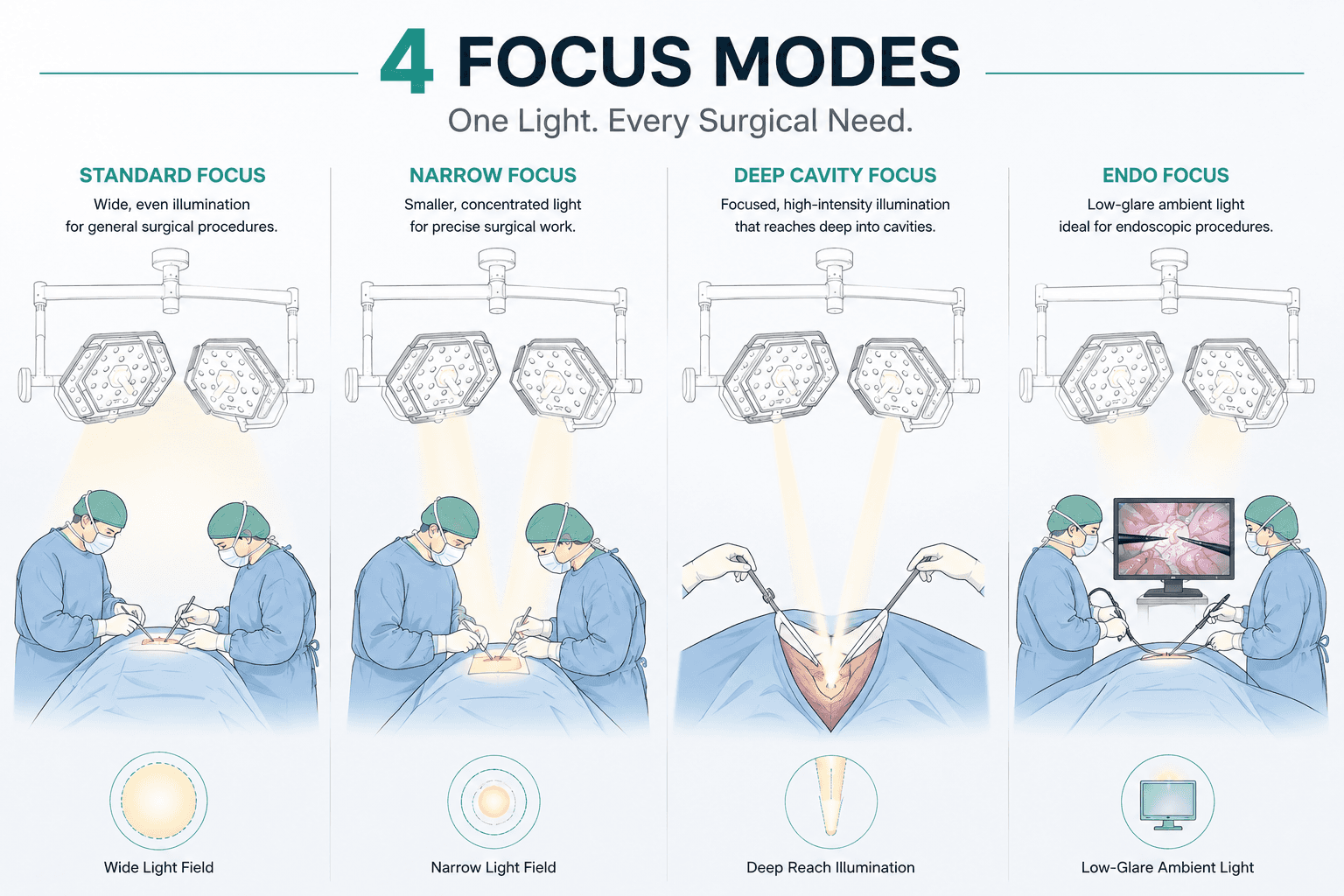
What Are the Different Focus Modes in Modern Surgical Theatre Lights?
What Are the Different Focus Modes in Modern Surgical Theatre Lights?

How Advanced MedTech Solutions Are Improving Surgical Precision and Efficiency
How Advanced MedTech Solutions Are Improving Surgical Precision and Efficiency

Products
Get in touch


info@matrixmedicals.in

+91 7304411451
+91 9821235552
Copyright © 2026 Matrix Medicals Pvt. Ltd., All rights reserved.
Products
Get in touch
info@matrixmedicals.in
+91 7304411451
+91 9821235552
Copyright © 2026 Matrix Medicals Pvt. Ltd., All rights reserved.
Contact Us
Contact Us
Contact Us