Hospital Equipment List Checklist: What to Plan Before Setting Up a New Hospital
Hospital Equipment List Checklist: What to Plan Before Setting Up a New Hospital

Share:
Share
Planning the Right Equipment for a New Hospital Starts Here
Setting up a new hospital involves hundreds of decisions, from clinical departments and infrastructure to staffing and technology. Among these, preparing the right hospital equipment list deserves careful attention because the equipment selected will influence everyday clinical workflows for years.
But an effective medical equipment list is not simply a collection of devices that every hospital is expected to have. A 50-bed surgical hospital, for example, will have very different requirements from a large multispecialty facility.
Hospital size, specialties, expected patient volumes, infrastructure, budgets and future expansion should all influence equipment decisions. Here is a practical checklist for approaching the process systematically.
1. Define Clinical Services Before Selecting Equipment
Before preparing a hospital equipment list, start with the services the facility intends to provide.
Consider:
Total number of beds
Clinical specialties
Number and type of operating theatres
ICU and critical care capacity
Emergency services
Expected surgical and procedure volumes
Diagnostic facilities
Future departments and expansion plans
These decisions establish the foundation of the medical equipment list. A hospital performing advanced minimally invasive procedures, for instance, may require technologies that would not be necessary for a smaller general healthcare facility.
WHO's guidance on medical-device procurement also places needs assessment and planning before procurement, including consideration of equipment specifications, quantities, infrastructure and available resources.
2. Build the Hospital Equipment List Department by Department
Instead of creating one long master list, organize the hospital equipment list according to departments and clinical areas.
Hospital Area | Equipment Categories to Consider |
Operation Theatre | OT lights, OT tables, electrosurgical units, anesthesia systems, surgical monitors, ceiling pendants |
Minimally Invasive Surgery | Endoscopic imaging systems, camera systems, LED light sources, insufflation systems |
ICU & Critical Care | Ventilators, patient monitors, infusion pumps, syringe pumps |
Emergency Department | Defibrillators, patient monitors, ventilators, resuscitation equipment |
Diagnostic Imaging | X-ray, ultrasound and other imaging equipment |
Laboratory | Diagnostic and laboratory equipment |
CSSD | Sterilization and instrument-processing equipment |
Patient Wards | Hospital beds, patient monitors and supporting equipment |
This department-wise approach makes the medical equipment list easier to review with clinicians, biomedical engineers, procurement teams, and hospital planners. It also helps identify equipment quantities and technologies that need to work together.
3. Plan the Operation Theatre as a Complete System
The operation theatre is one area where individual equipment decisions are closely connected.
A simple way to look at the surgical workflow is:
Surgical Illumination → Patient Positioning → Surgical Energy → Visualization → Video & Data Management
A modern OT may therefore bring together OT lights, operation theatre tables, electrosurgical generators, endoscopic imaging systems, surgical displays and audio-video technologies.
Our portfolio covers these core surgical areas, allowing hospitals to consider how different technologies fit within the complete OT workflow.
For advanced OTs, planning may also include an OR integration system that connects video and information sources within the surgical environment. Thinking about integration during the initial planning stage can prevent hospitals from ending up with multiple standalone technologies that are difficult to connect later.
4. Check Infrastructure Before Finalizing Equipment
A suitable device on paper may not be suitable for a particular hospital if the infrastructure cannot support it.
Before finalizing the hospital equipment list, consider:
Electrical requirements and backup power
Medical gas connections
Ceiling structure and mounting points
Room dimensions
HVAC requirements
Network and data connectivity
Installation and equipment movement space
This is especially important for operating theatres. OT lights and ceiling pendants require appropriate structural planning, while an OR integration system may require network, display, cabling, and connectivity considerations.
Equipment and infrastructure planning should therefore happen together rather than at different stages of the project.
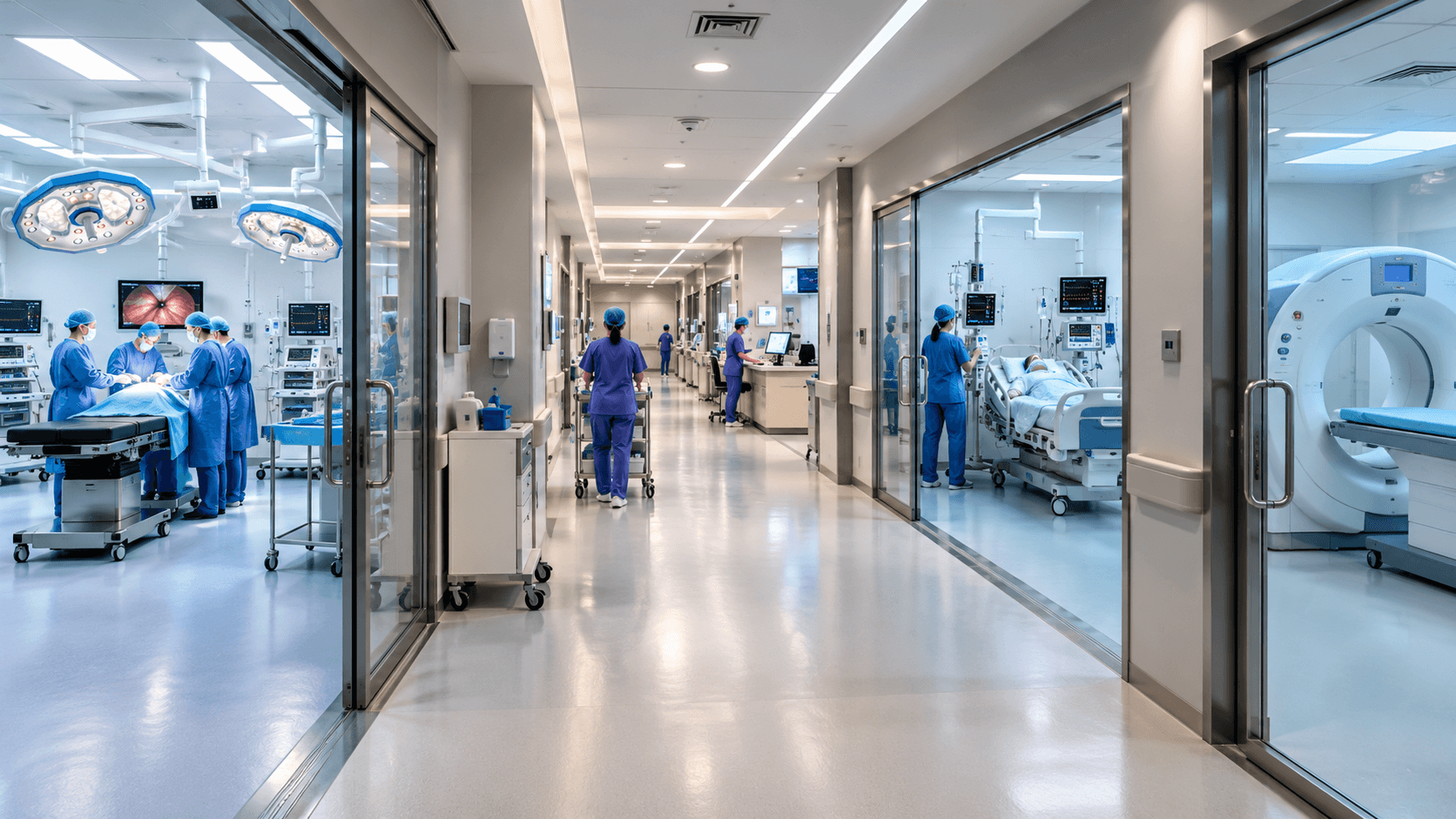
5. Look Beyond the Initial Purchase Price
Budget will always influence the medical equipment list, but purchase price alone does not show what a device will cost over its working life.
Hospitals should also consider:
Accessories and consumables
Preventive maintenance
Calibration
Spare-part availability
Service contracts
Staff training
Expected equipment life
Potential downtime
A lower initial quotation may not provide better long-term value if maintenance is difficult; consumables are expensive, or technical support is limited.
Considering total cost of ownership makes the hospital equipment list more useful as a long-term planning document rather than simply a procurement checklist.
6. Plan Installation, Training and After-Sales Support
Equipment planning should continue beyond delivery.
Installation, commissioning, and user training should be discussed during procurement. Hospitals should also know how preventive maintenance, calibration, breakdown support and spare-part requirements will be handled.
This is particularly important for critical equipment used in operating theatres, ICUs, and emergency departments.
The medical equipment list can therefore include additional fields for installation requirements, warranty, training, preventive maintenance and service support instead of recording only product names and quantities.
7. Consider Future Expansion and OR Integration
A hospital's technology requirements will continue to evolve after it opens.
New specialties may be introduced; additional operating theatres may be commissioned, and surgical imaging or documentation requirements may change.
This makes future compatibility an important part of the hospital equipment list.
Hospitals planning advanced operating rooms should consider whether an OR integration system may be required now or in the future. Such systems can bring surgical video sources, displays, recording, and communication into a more connected environment.
Our OR Infinity OR integration system, for example, is designed around centralized visualization, video routing, recording, and communication requirements within modern operating theatres.
Considering these requirements early can make future upgrades easier than trying to integrate several independent systems after the OT is operational.
8. Final Hospital Equipment List Checklist
Before approving the final hospital equipment list, confirm:
☐ Clinical and specialty requirements
☐ Department-wise equipment requirements
☐ Equipment quantities
☐ Technical specifications
☐ Infrastructure compatibility
☐ Installation requirements
☐ Staff and user training
☐ Preventive maintenance and calibration
☐ Service and spare-part availability
☐ Total cost of ownership
☐ Future expansion requirements
☐ OR and technology integration
Conclusion
A well-prepared hospital equipment list should answer more than one question: not just what does the hospital need, but also where will it be used, what infrastructure does it require, who will operate it, how will it be maintained and can it support future requirements?
For surgical departments, this also means considering OT lights, tables, electrosurgical systems, endoscopic imaging, and an OR integration system as parts of the wider surgical environment.
Building the medical equipment list around these practical considerations can help hospitals make more coordinated procurement decisions and create facilities that are ready for both current clinical needs and future growth.
Planning the Right Equipment for a New Hospital Starts Here
Setting up a new hospital involves hundreds of decisions, from clinical departments and infrastructure to staffing and technology. Among these, preparing the right hospital equipment list deserves careful attention because the equipment selected will influence everyday clinical workflows for years.
But an effective medical equipment list is not simply a collection of devices that every hospital is expected to have. A 50-bed surgical hospital, for example, will have very different requirements from a large multispecialty facility.
Hospital size, specialties, expected patient volumes, infrastructure, budgets and future expansion should all influence equipment decisions. Here is a practical checklist for approaching the process systematically.
1. Define Clinical Services Before Selecting Equipment
Before preparing a hospital equipment list, start with the services the facility intends to provide.
Consider:
Total number of beds
Clinical specialties
Number and type of operating theatres
ICU and critical care capacity
Emergency services
Expected surgical and procedure volumes
Diagnostic facilities
Future departments and expansion plans
These decisions establish the foundation of the medical equipment list. A hospital performing advanced minimally invasive procedures, for instance, may require technologies that would not be necessary for a smaller general healthcare facility.
WHO's guidance on medical-device procurement also places needs assessment and planning before procurement, including consideration of equipment specifications, quantities, infrastructure and available resources.
2. Build the Hospital Equipment List Department by Department
Instead of creating one long master list, organize the hospital equipment list according to departments and clinical areas.
Hospital Area | Equipment Categories to Consider |
Operation Theatre | OT lights, OT tables, electrosurgical units, anesthesia systems, surgical monitors, ceiling pendants |
Minimally Invasive Surgery | Endoscopic imaging systems, camera systems, LED light sources, insufflation systems |
ICU & Critical Care | Ventilators, patient monitors, infusion pumps, syringe pumps |
Emergency Department | Defibrillators, patient monitors, ventilators, resuscitation equipment |
Diagnostic Imaging | X-ray, ultrasound and other imaging equipment |
Laboratory | Diagnostic and laboratory equipment |
CSSD | Sterilization and instrument-processing equipment |
Patient Wards | Hospital beds, patient monitors and supporting equipment |
This department-wise approach makes the medical equipment list easier to review with clinicians, biomedical engineers, procurement teams, and hospital planners. It also helps identify equipment quantities and technologies that need to work together.
3. Plan the Operation Theatre as a Complete System
The operation theatre is one area where individual equipment decisions are closely connected.
A simple way to look at the surgical workflow is:
Surgical Illumination → Patient Positioning → Surgical Energy → Visualization → Video & Data Management
A modern OT may therefore bring together OT lights, operation theatre tables, electrosurgical generators, endoscopic imaging systems, surgical displays and audio-video technologies.
Our portfolio covers these core surgical areas, allowing hospitals to consider how different technologies fit within the complete OT workflow.
For advanced OTs, planning may also include an OR integration system that connects video and information sources within the surgical environment. Thinking about integration during the initial planning stage can prevent hospitals from ending up with multiple standalone technologies that are difficult to connect later.
4. Check Infrastructure Before Finalizing Equipment
A suitable device on paper may not be suitable for a particular hospital if the infrastructure cannot support it.
Before finalizing the hospital equipment list, consider:
Electrical requirements and backup power
Medical gas connections
Ceiling structure and mounting points
Room dimensions
HVAC requirements
Network and data connectivity
Installation and equipment movement space
This is especially important for operating theatres. OT lights and ceiling pendants require appropriate structural planning, while an OR integration system may require network, display, cabling, and connectivity considerations.
Equipment and infrastructure planning should therefore happen together rather than at different stages of the project.
5. Look Beyond the Initial Purchase Price
Budget will always influence the medical equipment list, but purchase price alone does not show what a device will cost over its working life.
Hospitals should also consider:
Accessories and consumables
Preventive maintenance
Calibration
Spare-part availability
Service contracts
Staff training
Expected equipment life
Potential downtime
A lower initial quotation may not provide better long-term value if maintenance is difficult; consumables are expensive, or technical support is limited.
Considering total cost of ownership makes the hospital equipment list more useful as a long-term planning document rather than simply a procurement checklist.
6. Plan Installation, Training and After-Sales Support
Equipment planning should continue beyond delivery.
Installation, commissioning, and user training should be discussed during procurement. Hospitals should also know how preventive maintenance, calibration, breakdown support and spare-part requirements will be handled.
This is particularly important for critical equipment used in operating theatres, ICUs, and emergency departments.
The medical equipment list can therefore include additional fields for installation requirements, warranty, training, preventive maintenance and service support instead of recording only product names and quantities.
7. Consider Future Expansion and OR Integration
A hospital's technology requirements will continue to evolve after it opens.
New specialties may be introduced; additional operating theatres may be commissioned, and surgical imaging or documentation requirements may change.
This makes future compatibility an important part of the hospital equipment list.
Hospitals planning advanced operating rooms should consider whether an OR integration system may be required now or in the future. Such systems can bring surgical video sources, displays, recording, and communication into a more connected environment.
Our OR Infinity OR integration system, for example, is designed around centralized visualization, video routing, recording, and communication requirements within modern operating theatres.
Considering these requirements early can make future upgrades easier than trying to integrate several independent systems after the OT is operational.
8. Final Hospital Equipment List Checklist
Before approving the final hospital equipment list, confirm:
☐ Clinical and specialty requirements
☐ Department-wise equipment requirements
☐ Equipment quantities
☐ Technical specifications
☐ Infrastructure compatibility
☐ Installation requirements
☐ Staff and user training
☐ Preventive maintenance and calibration
☐ Service and spare-part availability
☐ Total cost of ownership
☐ Future expansion requirements
☐ OR and technology integration
Conclusion
A well-prepared hospital equipment list should answer more than one question: not just what does the hospital need, but also where will it be used, what infrastructure does it require, who will operate it, how will it be maintained and can it support future requirements?
For surgical departments, this also means considering OT lights, tables, electrosurgical systems, endoscopic imaging, and an OR integration system as parts of the wider surgical environment.
Building the medical equipment list around these practical considerations can help hospitals make more coordinated procurement decisions and create facilities that are ready for both current clinical needs and future growth.
Article support
Frequently asked questions
Frequently asked questions
Frequently asked questions
What should be included in a hospital equipment list?
How do you prepare a medical equipment list for a new hospital?
What equipment is required for a modern operation theatre?
What should hospitals consider before purchasing medical equipment?
Why is an OR integration system important in a modern hospital?
Share:
Share
RELATED ARTICLES
Read more from our blogs

How Advanced MedTech Solutions Are Improving Surgical Precision and Efficiency
How Advanced MedTech Solutions Are Improving Surgical Precision and Efficiency

How Hospitals Should Evaluate Medical Equipment Before Procurement
How Hospitals Should Evaluate Medical Equipment Before Procurement

C-Arm Compatible OT Tables: What Hospitals Should Check Before Buying
C-Arm Compatible OT Tables: What Hospitals Should Check Before Buying

How MedTech Companies Can Scale From Local Markets to Global Markets
How MedTech Companies Can Scale From Local Markets to Global Markets

Products
Get in touch


info@matrixmedicals.in

+91 7304411451
+91 9821235552
Copyright © 2026 Eclipse Prism Medical Devices (EPMD), All rights reserved.
Products
Get in touch
info@matrixmedicals.in
+91 7304411451
+91 9821235552
Copyright © 2026 Eclipse Prism Medical Devices (EPMD), All rights reserved.
Contact Us
Contact Us
Contact Us